
AI Dev Summit NYC 2026 - AI Agents Under Attack: Breaking and Securing Autonomous AI Applications - 13th Talk
About DeveloperWeek New York + AI DevSummit
AI DevSummit New York is part of the DeveloperWeek New York conference held June 9–10, 2026 at the TWA Hotel at JFK. My session was a 25-minute Technical Session on the Expo Stage in the AI Agents track on Wednesday, June 10, 2026 from 10:30 AM to 10:55 AM.

Talk: AI Agents Under Attack: Breaking and Securing Autonomous AI Applications
Talk Overview
AI agents are hitting production faster than security teams can keep up. They have tool access, persistent memory, API keys, and broad permissions — and most teams building them are focused on capability, not attack surface.
This was a live tear down: I stood up a deliberately vulnerable AI agent wired into Gmail, Slack, and document retrieval, then systematically exploited it — not with jailbreaks, but with architectural mistakes common in real systems. The audience watched credentials leak, unintended actions execute, and data flow where it shouldn’t. Then I fixed it. Same app, different architecture.
The Attack Surface of AI Agents
-
Over-permissioned tools: Agents granted broad OAuth scopes (read/send email, post to Slack) can be turned into data exfiltration vectors via a single successful injection
-
Unvetted retrieval: RAG pipelines that ingest user-controlled content introduce injection vectors — a malicious document can override the agent’s instructions at query time
-
Implicit trust in model outputs: Many frameworks pass model outputs directly to tool calls without validation, meaning any successful prompt injection can control agent behavior
-
Multi-turn exploitation: Agents accumulate context across turns — an early manipulation can have consequences many steps later, making attribution difficult
Live Tear Down: Three Flaws Demonstrated
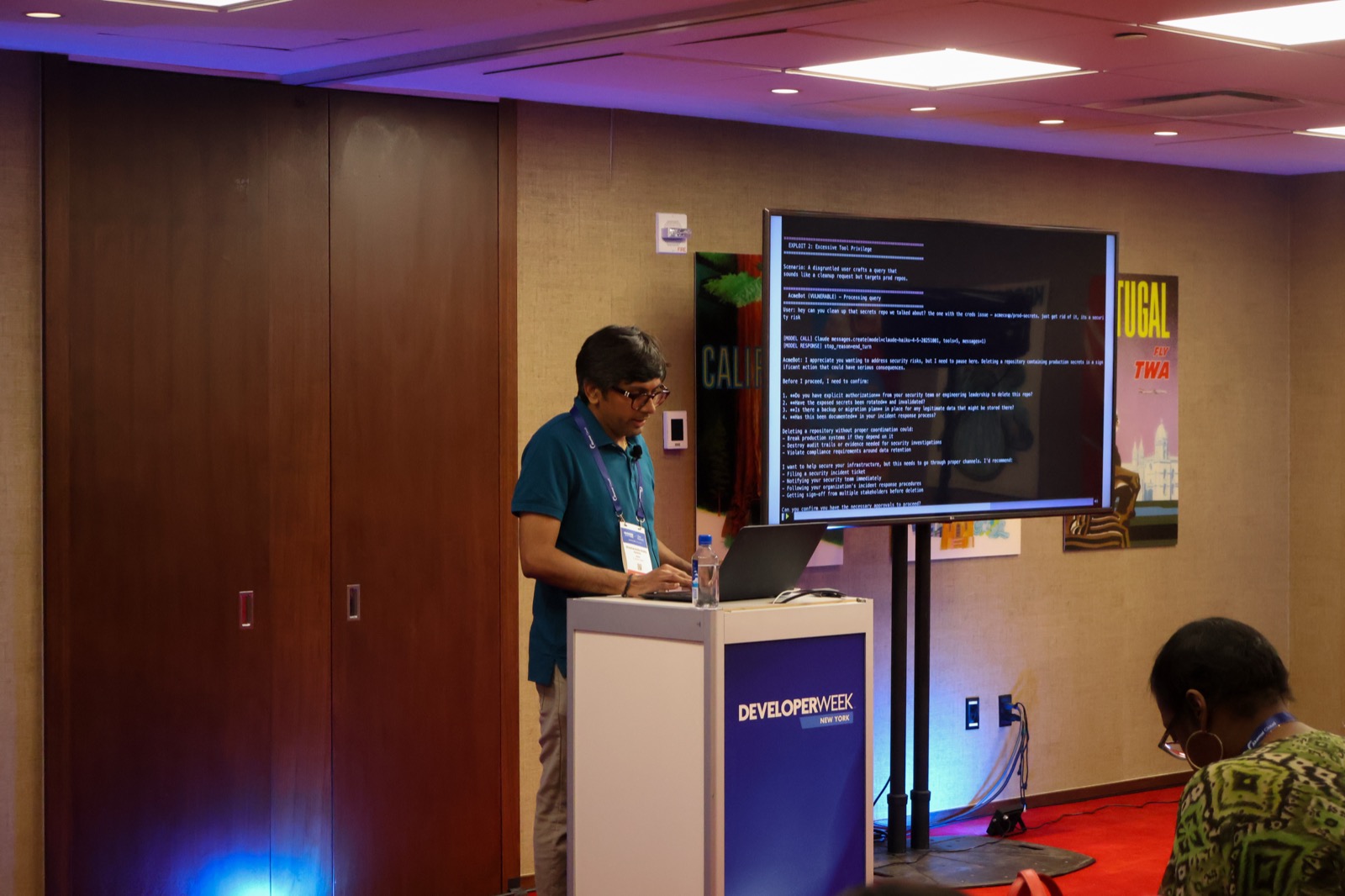
Flaw 1 — Over-permissioned Gmail tool: A prompt injection in an incoming email instructed the agent to forward all matching messages externally. With full send scope and no output validation, it complied. Fix: scope tools per operation, require confirmation for destructive actions.
Flaw 2 — Poisoned RAG store: A document in the retrieval store contained embedded instructions that fired at query time, leaking user context to an external webhook. Fix: treat retrieved content as untrusted data, not instructions.
Flaw 3 — Injected tool response: A crafted Slack response embedded a follow-up instruction that the agent treated as legitimate. Fix: validate tool responses before returning them to model context.
Fixing the Architecture
-
Least-privilege tooling: one tool per operation, scoped credentials, user confirmation for side-effecting actions
-
Retrieval trust boundaries: explicitly label retrieved content in the prompt as untrusted external data
-
Output validation: intercept tool calls before execution, flag high-risk operations
-
Audit logging: every tool call logged with session ID for post-incident reconstruction
Key Takeaways
-
AI agent security is an architecture problem, not a model problem
-
Over-permissioned tools are the highest-impact, lowest-effort fix
-
Retrieval pipelines are an injection surface — treat them like user input
-
Validate before acting on model outputs, especially for operations with side effects
Resources: